Advocating for agriculture
Feb 2, 2026 by Robert Herrington, INFB Marketing
In the northeast corner of Indiana, one particular issue farmers are seeing is in the skies. Drones are flying across their fields and above their livestock and barns. With the rise of Highly Pathogenic Avian Influenza and other communicable diseases, these aircraft are causing concerns that they could be helping spread illness from property to property through their travels.
Authored by Rep. Kendell Culp (R, IN-16), who also serves as Indiana Farm Bureau vice president, House Bill 1064 makes the repeated operation of an unmanned aerial vehicle (UAV) over private property a nuisance, with both civil and criminal penalties, including an increased penalty if it involves agricultural property. At the time of publication, HB1064 had its first reading on Dec. 15 and was referred to the committee on courts and criminal code.
UAV protections is one of many issues INFB is working with legislators on during this short session. Engaging in policy is a foundation of INFB membership and President Randy Kron said the policy issues come directly from our members.
“Our policy is very grassroots driven. It actually starts at the county level – all 92 counties have discussions about policy and what’s important to them. They will create state- and county-level recommendations. The resolutions committee hears these recommendations and provides uniformity for those policies that may be similar or address the same topic,” he said. “The committee then presents the recommendations at the INFB delegate session in August, which brings together voting members from across the state. We spend the day having debate, discussing the issues and what our policy should be for the next year. It’s very unique, but when we are at the Statehouse, we know our policy is what our members want.”
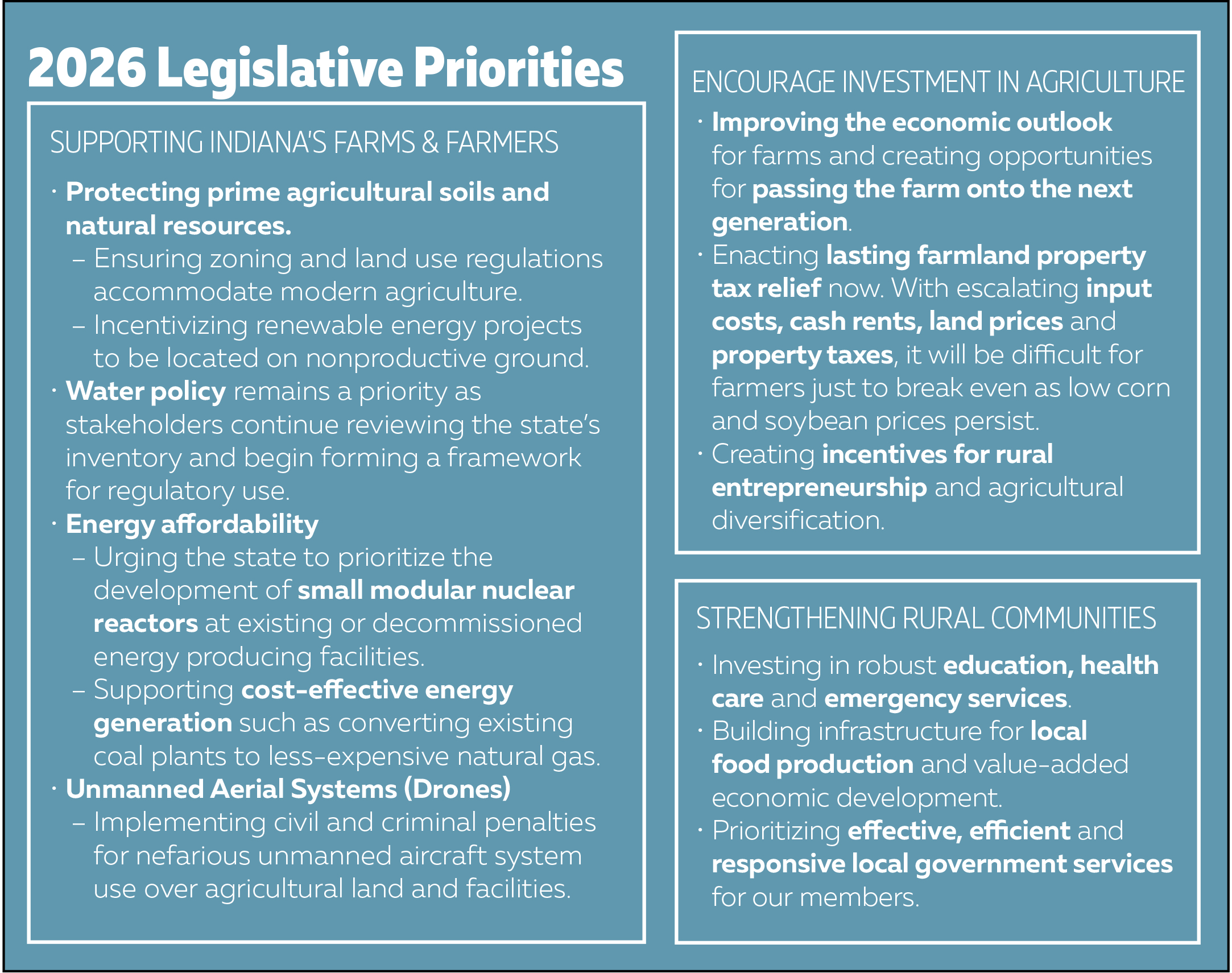
With this year’s state legislative session being a short one, INFB has focused on three guiding principals – encouraging investment in agriculture, supporting Indiana’s farms and farmers and strengthening rural communities.
Encouraging investment in agriculture
“If you look at agriculture across the state, the row crop side of this equation has tight margins and finding a profit right now is really tough. Livestock may be a little bit better, but we’re trying to find ways to help them,” Kron said, adding it may be through trade or having access to different markets.
Strengthening rural communities
INFB Executive Director of Public Policy Katie Nelson said this objective focuses on how Indiana can invest in the education, healthcare and emergency services in local communities, as well as in that local food production and the value-added economic development when farms are struggling in this economy.
“We want to be able to support those that are trying to diversify whether that’s getting more into livestock or whether it’s more on a small scale – that they have a smaller business or whether they’re doing specialty crops. We’re trying to figure out how to remove barriers for that and help them get access to a larger market while also balancing that food security?” she said.
Supporting Indiana's farms and farmers
“Food security is national security, and part of that is protecting the prime agriculture soils of Indiana. Indiana State Department of Agriculture did a study a few years ago about the inventory of lost farmland and they found that Indiana has lost about 350,000 acres from 2010 to 2022. That is not a small number, and not something that we should take lightly,” said Nelson. “Our members are focused on preserving that farmland and more siting projects, especially renewable energy projects. We must carefully think about where we put those, because it’s a balancing act when it comes to development between property rights and local control.”
With a short session comes unpredictability at the Statehouse.
“Just like our farmers are facing uncertainty, I think we are having some uncertainty about what this legislative session might bring compared to previous years,” said Nelson. “It’s not a budget year so it’s hard to look out and forecast what this session might bring, but we’re prioritizing the issues that our members care about, and I think there’ll be some opportunities to get some wins, especially when it comes to issues like drones, food policy, and hopefully there’s an opportunity to make tweaks to property taxes. Our team will be right there with some proposed solutions.”
Behind the scenes, Farm Bureau staff reads through every line of legislation that is presented, because as Kron said, “you never know what two sentences on page 25 could have real negative impacts on agriculture.”
“A lot of times we focus on what we get passed and we call that a victory. Sometimes there’s legislation that’s not favorable to agriculture and getting those bills killed can be more important than getting some passed,” he said.
INFB is also beginning talks and planting seeds on energy issues within the state.
“Our members said they want nuclear energy to be the preferred source of energy, particularly if we can site those on existing or decommissioned coal plants,” said Nelson. “It’s something that the state needs to be looking into and investing in a plan going into the future.”
“A lot of times you say nuclear and people’s hair catches fire, but we’ve come a long way, and these are smaller facilities,” added Kron. “We’ve run submarines and other things for a lot of years on nuclear reactors and our members have realized that and they would prefer that over covering up a lot of farmland with solar products.”
This year also consists of midterm elections. INFB’s AgELECT and ELECT Political Action Committees are there to help support those ag-friendly candidates.
“It’s important to our Statehouse team when we’re in session for us to be able to rely on candidates who understand and want to support rural Indiana and our members,” Nelson said. “Through the endorsement process, we work to identify those at the local level, and then we can hopefully rely on them for votes or almost more importantly, that they are willing to stand up for issues and stop that legislation from going through.”
Kron said INFB is fortunate that Indiana’s legislature is favorable towards agriculture.
“I know some of my counterparts in other large agricultural states really struggle in their statehouses and that makes me pause sometimes and realize how fortunate we are, but it also reminds me we can’t take that for granted and things could change pretty quick,” he said. “The agriculture community needs to get out, do their research and make sure we elect leaders that are going to be supportive of agriculture and our rural communities.”
While it is a short session, there is not a shortage of issues facing our members. Kron encourages all members to get involved and use Farm Bureau as a resource to help understand the issues and policies impacting the state.
“Talk to candidates and build relationships. Building relationships with legislators is critical because you don’t want to be talking to them for the first time and asking them to vote for or against an issue that may critically impact you,” he said. “They need to know who you are and you are a trusted resource. When you build that relationship and then you reach out that a certain bill is good for agriculture and give the reasons why, the legislator will trust you and is more likely to support it.”


